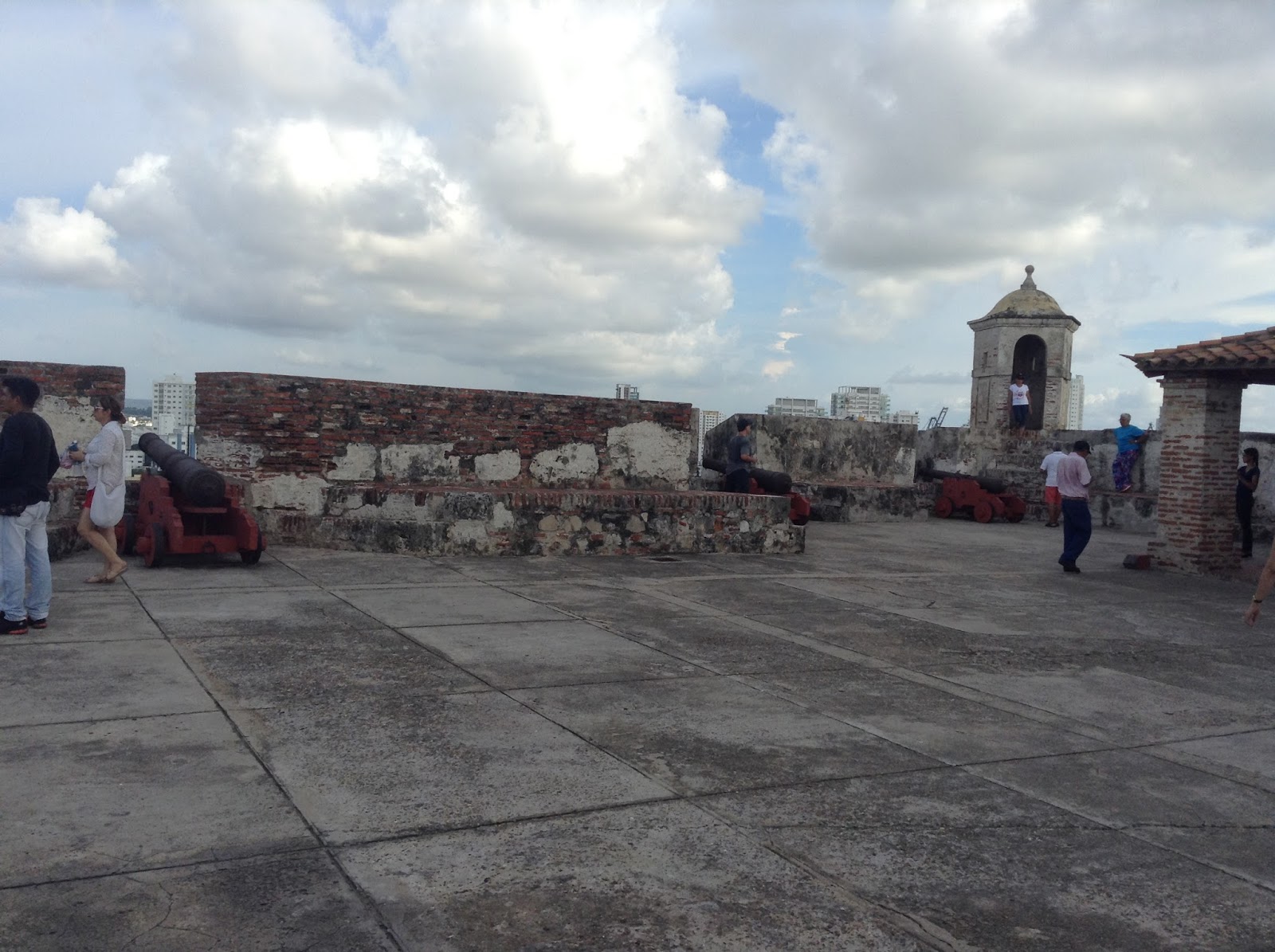
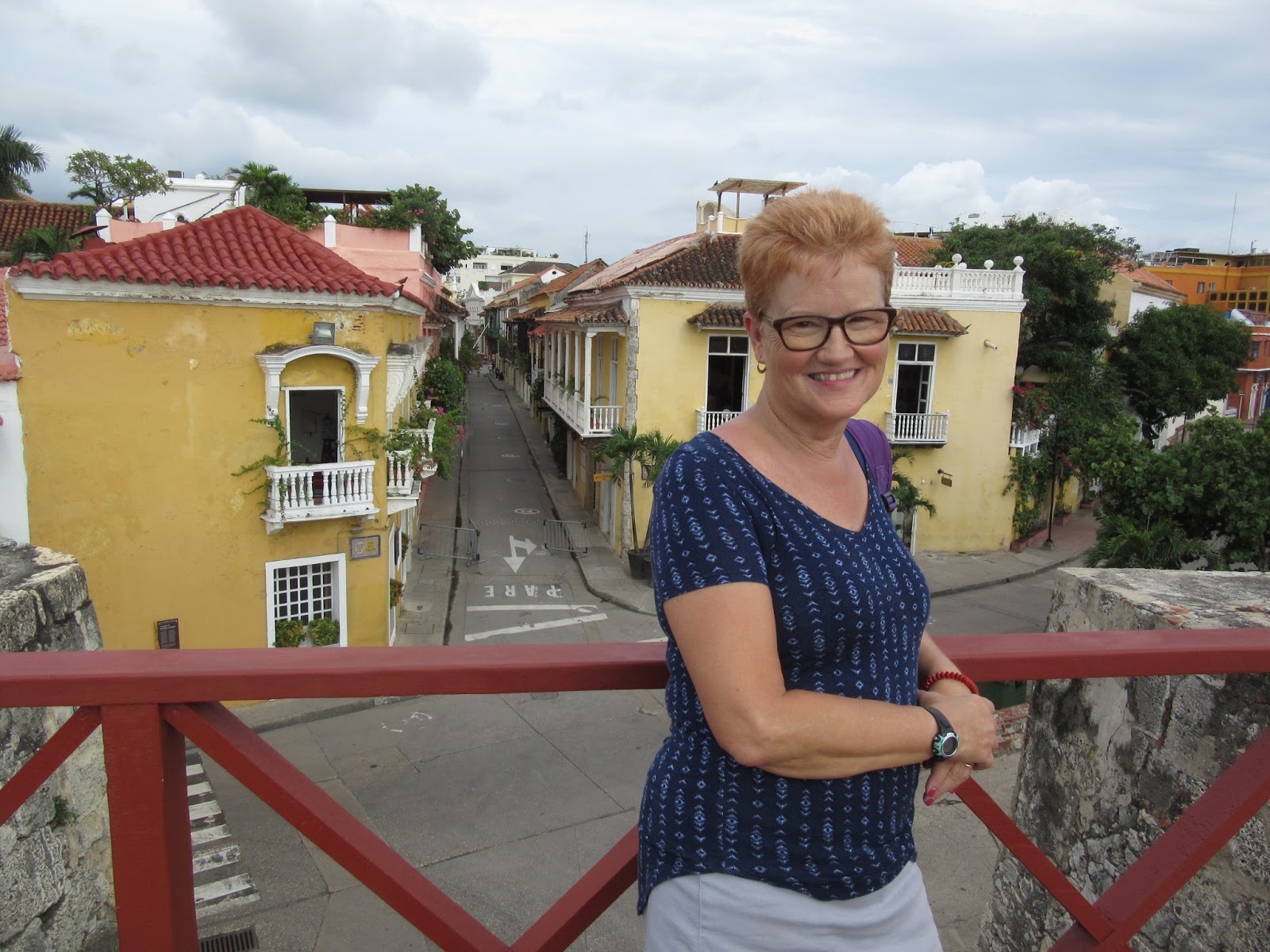
Just like the previous posts about Cartagena, this one is also an amalgamation of places we saw in the old town several times during our few days in the wonderful colonial city. I have included them in this post because they seemed to best 'fit' here or because the sites were finally open after attempting to visit them on prior days!


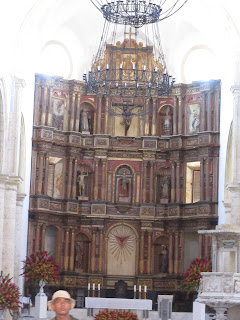




Work on Cartagena’s Cathedral, also called the Minor Basilica, was begun in 1575 but it was
partially destroyed a few years later thanks to Francis Drake’s cannons. It was
finally completed in 1612.


We had to content ourselves with a quick glimpse from just outside the entrance but we didn’t complain as it had been closed the other two days we’d try to visit it.


The simply decorated interior had three naves and massive semicircular archways supported on high stone columns.

The main altar, made of wood and gold leaf, dated from the 18th century.

Some of the stations of the cross from where we were standing looked like tapestries. It would have been a treat being able to walk into the cathedral and get a real 'feel' for it but at least we saw it on our third try.


The sundial on the side of the building accurately told the time but it only works from September to March as the angle of the sun doesn't reach the sundial the rest of the year.

On the side facade of the Cathedral was the Plaza de la Proclamacion, the site of proclamations (duh!), speeches and great religious celebrations. It was also the place where the people of Cartagena gathered on December 11,1811, to endorse the Declaration of Independence. Now adays, all kinds of cultural activities are performed in the plaza.
Government Palace, the unfinished building behind the plaza, was in the process of being restored. Though it was supposed to have been completed three months ago, it looked like it had a long way to go still.

Directly behind the Cathedral and kitty corner to the plaza was a bronze statue marking the visit of Pope John Paul II to Cartagena in 1986. The pontiff came to Colombia to mourn the loss of over 23,000 victims who died from a mudslide caused by the eruption of a volcano. During his week-long visit, the pope repeatedly condemned the country’s guerrillas who traded in cocaine.

I wonder if there'll be a companion statue next year marking Pope Francis' visit to the city and his push for peace in Colombia after 52 years of civil conflict in the country?

Since I'm on the topic of churches, I don't want to forget about the Cloister of Santo Toribio, a small church in the San Diego part of the old town that was luckily open our last day in town. Erected
between 1666 and 1732, the ceiling was covered with paneling.


When the city was attacked in 1741, a cannonball went through a window when the church was filled with worshippers. Fortunately, there were no casualties. As mass was being said, we didn’t get a chance to see the cannonball on display in a glassed niche on a side wall.

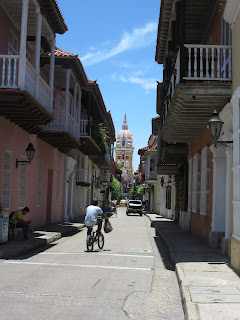
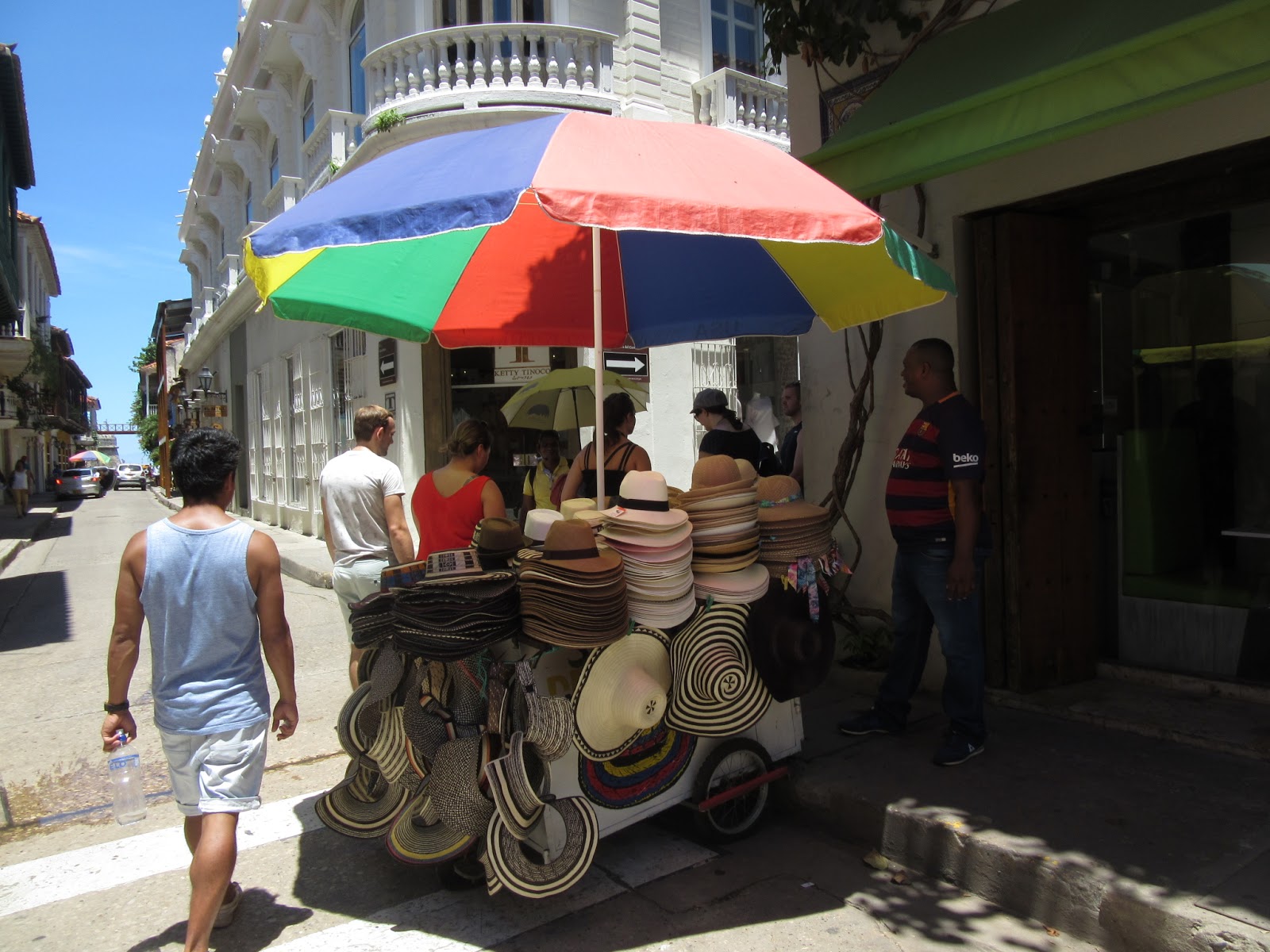
Walking through the old town was a fun experience each time we did it. We never quite knew what to expect as we rounded the next corner. Would it be a peddler selling fruit from his push cart? Would it be hawkers selling sunglasses from a display case as they walked from person to person? Might it be someone selling sombreros as in the photo below? Or someone selling agua fria from a particularly ratty foam chest? The options to separate us from our money seemingly knew no bounds. We quickly both got used to saying non, gracias!
I mentioned in a previous post that Cartagena
was declared an UNESCO city in 1984. Part of that designation was because the local
laws had dictated that all the homes and businesses in the old town had to be one
of the following styles: colonial, republican or eclectic. It was interesting that, in just one intersection, there were three buildings, one on each corner, representative of the different styles.
In addition, buildings in the old town could only be two floors; this building ‘qualified’ as the owner declared that the middle floor was only a half floor and therefore it didn’t count! The main or first floor was always used for business dealings and the upper floor was used as the family residence.This was an example of the colonial style.
In addition, buildings in the old town could only be two floors; this building ‘qualified’ as the owner declared that the middle floor was only a half floor and therefore it didn’t count! The main or first floor was always used for business dealings and the upper floor was used as the family residence.This was an example of the colonial style.

This building had been made in the eclectic style, our walking tour guide told us the previous day, meaning a mixture of styles.
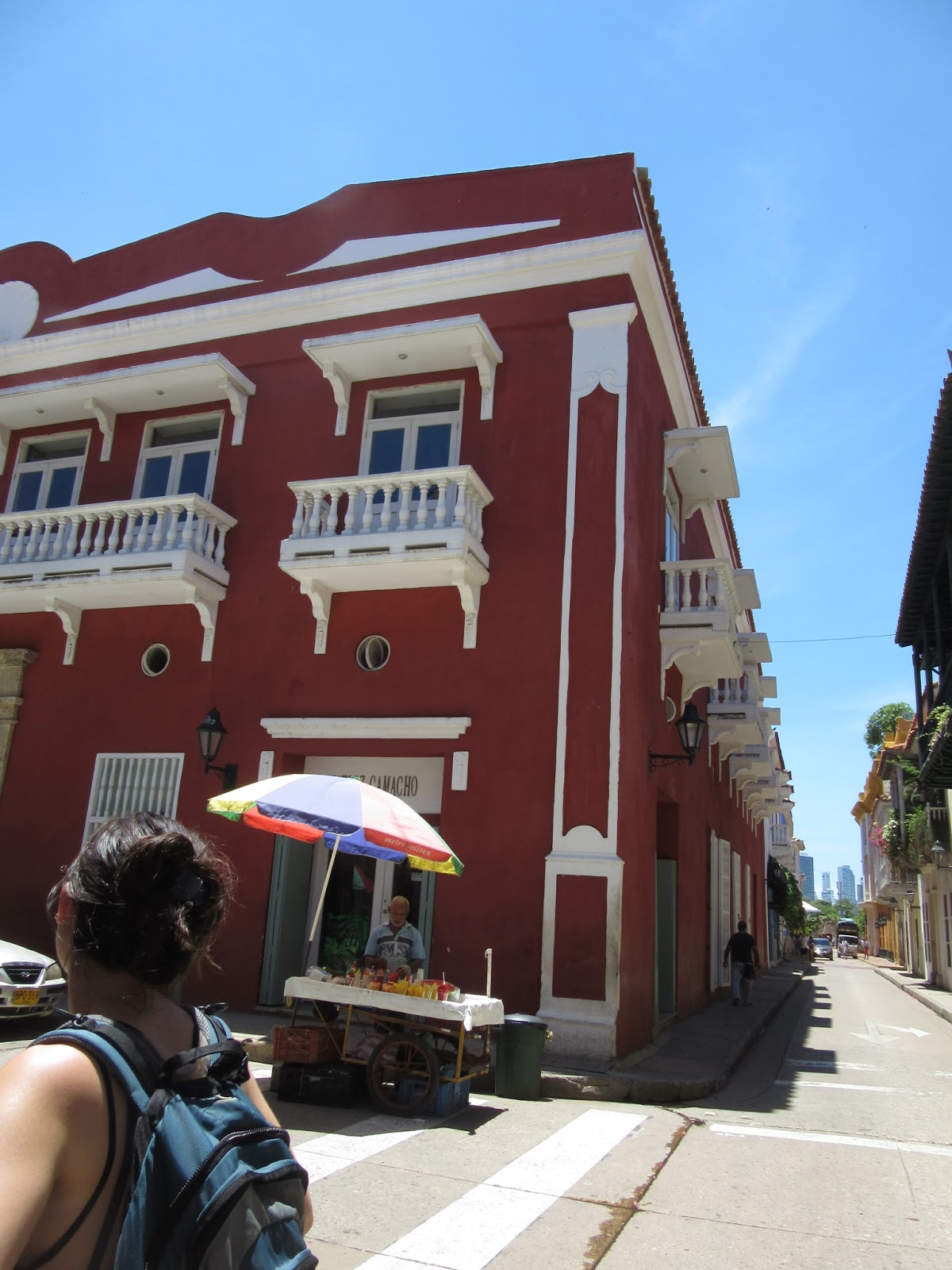
My favorite one was this charming republican-style building which had French architectural influences. Sometimes,
the authorities could overlook the fact if buildings weren’t one of those three
styles; i.e. bribery was alive and well in Cartagena!

Doors in the ritzier neighborhood of the old city, i.e.in the El Centro area where the churches and plazas were, were wider and taller than usual. The more decorated the door, it meant the more money you have in the home. If there was a hand doorknocker, that indicated there was a priest living there in colonial times.

Our guide indicated there are six distinct social classes in Colombia, based on race. House taxes, paid annually, are dependent on the number of modern TVs, the quality of flooring throughout the home, the number of bedrooms, etc. Our guide intimated that there's a fair amount of shuffling of furniture around from one home to another before the tax inspector comes each year!
Homeowners in the top couple of classes pay part of their taxes to support those citizens in the lowest classes who need financial assistance with their accommodation. We learned that welfare is only provided for children and seniors in the first and second classes, i.e. the two lowest rungs.


A fish doorknocker meant a businessman lived there; a lion one indicated the presence of the military and an iguana indicated a royal personage, i.e. a count, etc. was living there.

I loved this view of flower-bedecked balconies and the Cathedral in the background.

The Palace of the Inquisition, located directly across from Simon Bolivar Park and two minutes from the Cathedral, was one of two starred attractions in Cartagena so we were glad it was
finally open on our final day and third attempt to see it. Though it was one of the most
attractive buildings in the city, its past told a different story as it housed
the notoriously grizzly Spanish Inquisition whose task it was to stamp out heresy in
colonial Cartagena. I took the photo from inside the park looking through to the Palace.

A small
window with a cross on top on a side wall, just around the corner from the
entrance, was where heretics could be denounced.


The palace was actually a combination of three tall houses and one short house, the latter since disappeared, constructed in 1770 to serve as headquarters to the Court of the Holy Office of the Inquisition. After Independence and through the rest of the 19th and most of the 20th century, the house was in private hands until the government appropriated it for the museum.

The stunning interior courtyard belied its horrific past.

In the 12th century, what would become one of the first primitive forms of inquisition in medieval times was started in Europe: a tool imposed and used by the Catholic Church to confront heresy. The Papal Inquisition was created from 1231-1233 by Pope Gregory IX who conferred legal status to the Inquisition which was consolidated in France, Germany and Italy.

In 1478, under the reign of Castilla and Aragon and with the authorization of Pope Pius IV, the Inquisition was formally ratified in Spain. Six years later, the Spanish throne was given control and, from that moment on, persecuting heretics became a political as well as a religious matter.
Books by such famous authors as Victor Hugo and Gustave Flaubert were banned.
Books by such famous authors as Victor Hugo and Gustave Flaubert were banned.

Methods
of torture included cutting off a woman’s breasts who was accused of being a
witch, having committed adultery or other crimes. Ouch and here I thought a
mammogram was sore!

Some
other horrific torture methods:
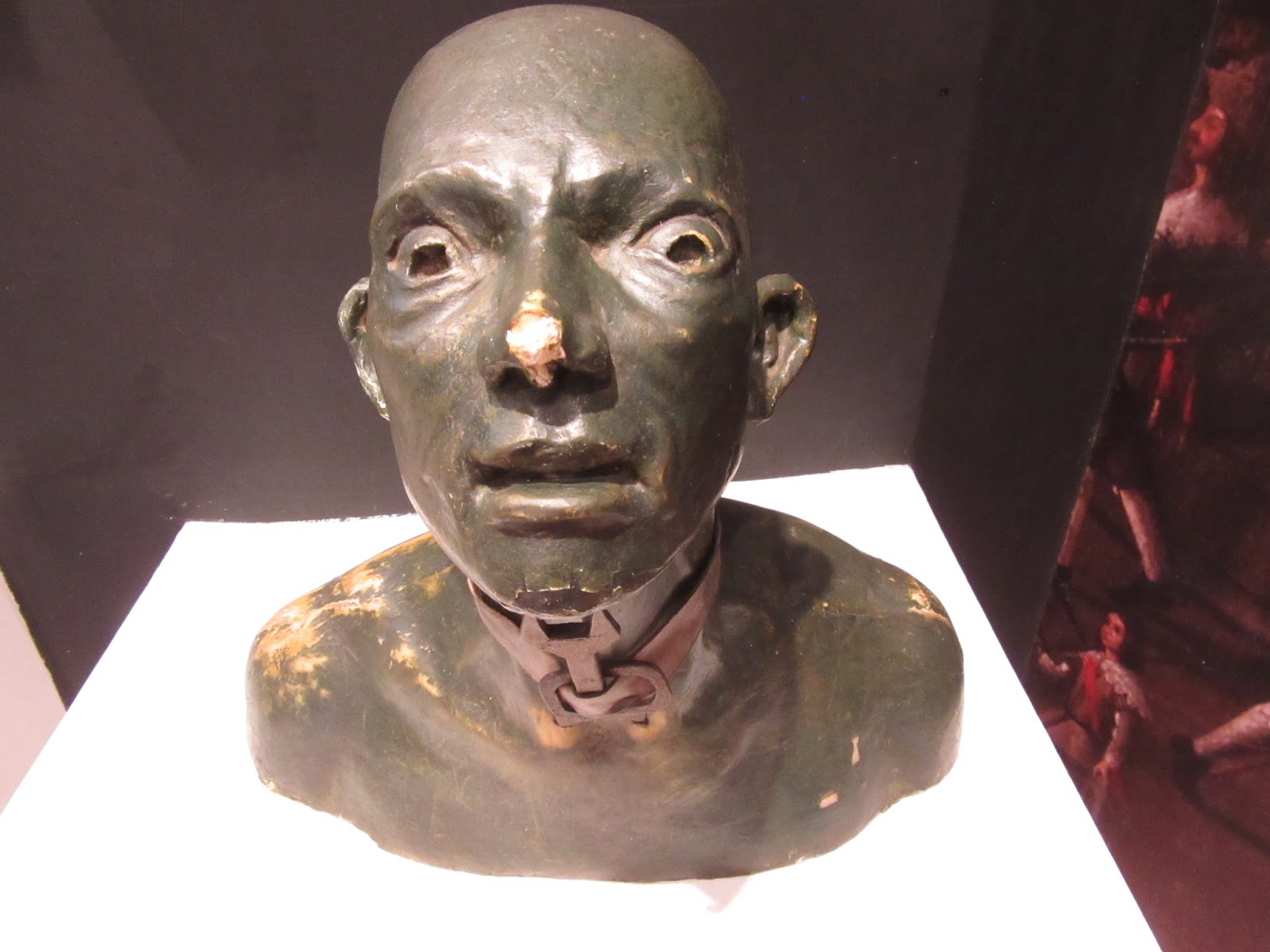

The Courtyard of the Cistern: This was a place to deposit water for human consumption. It was made of thick limestone walls, waterproofed with slaked lime stucco, plastered and prepared from a base of ash, tile dust and linseed oil. The ancient cistern worked by collecting rainwater from rooftops.

Three tribunals were set up in the Americas during the Inquisition: one in Mexico which brought 3,000 people to justice and killed 43 people. Lima’s tribunal, which ran from 1569-1820, detained 1,477 people and killed a further 32 people. The Court of the Holy Office of the Inquisition in Cartagena was in power from 1569 until 1821 and was responsible for the citizens in the city and also those in Puerto Rico, Venezuela and Panama. During that 211-year period, 811 people were charged with such ‘crimes’ as magic, witchcraft and blasphemy. Our guidebook indicated that number of people were actually executed AND not just charged; the museum stated there were ‘just’ 56 public executions and 5 people burned at the stake by 45 inquisitors.

In Cartagena, the importance of the port provided a main conduit of all sorts of forbidden goods including books, as well as merchants and foreigners from all over the world who brought with them 'their heretic cultures which attacked our faith.'


The response of the colonial authorities to these practises was fear: fear of the unknown and fear of the other cultures which worried them. They faced that fear with their best-known weapon: punishment. That was why witchcraft, sorcery, indigenous shamanism and other practises justified the existence of the Holy Office.
Outside,
we saw the guillotine. I never thought of it before but I read that it was
named after a French doctor. Guess he wasn’t a big follower of the Hippocratic
Oath! Steven decided not to put his head in the blocks for a picture this time!

It seemed particularly fitting that the berries on a tree in the courtyard of the Palace of the Inquisition were labeled toxic!


I guess it wasn't too much of a coincidence that the main Catholic Church in Cartagena, the one that supported the horrendous acts perpetrated by religious authorities, was just a stone's throw from the Palace.

Cartagena was a great introductory city for us to visit in Colombia: it was a beautiful colonial city with a very charming old town, the added bonus of its UNESCO designation and so many pleasing plazas. Above all, we were lucky enough to see the Pope charm its citizens and us!
Posted from Santa Marta, Colombia, on September 14th.