LINKS TO PREVIOUS TRIPS


To read about other countries we've visited, just click on the following links:

2013
Iceland, Finland, Estonia, Russia, Mongolia, China, Thailand, Cambodia and South Korea

2014
Germany, Poland, Austria, Hungary, Czech Republic, Romania, Bulgaria, Turkey, Israel, Jordan and Denmark

2015
Hawaii, Australia, Indonesia, Singapore, Vietnam, Laos, Myanmar, Malaysia, Nepal, India and England

2016
Latvia, Lithuania, Ukraine, Slovenia, Serbia, Bosnia & Herzegovina, Croatia, Montenegro, Kosovo, Macedonia, Albania, Greece, Egypt, Bahrain, Qatar, Oman, Ethiopia, Kenya, Zimbabwe, South Africa, U.A.E. and Denmark.

2018
France (Paris and Lourdes), Armenia, Georgia, Azerbaijan, Kazakhstan, Uzbekistan, Kyrgyzstan, Spain, Andorra, Morocco (Tangier), Portugal and the Netherlands (Amsterdam).

2019
New Zealand, Australia, Ireland, Great Britain, Antarctica, Patagonia and Paraguay.

Showing posts with label Cuenca. Show all posts

Saturday, October 28, 2017

10/4: Bust & Boon in Gualeco & Chordeleg Near Cuenca, Ecuador

Before meeting Nadine and Oliver, our two new Luxembourg acquaintances from our marathon hike in El Cajas National Park the previous day, and visiting the nearby rural communities of Gualaceo and Chordeleg, Steven and I popped into the Iglesia Santo Alfonso since it had been closed the other two times we passed it. 


Across the street from the church was the attractive cultural center. 
Oliver hadn’t seen the church so we went back again for a few minutes before taking a taxi to the bus station for the short trip to the town of Gualaceo first.
We got to the station literally just as the bus was pulling out of his spot but he wouldn’t wait one minute for Nadine and Oliver to find the .10 each for the station departure fee. We were fortunate that we didn’t have to wait long before another bus to depart. We obviously hadn’t done our ‘homework’ as none of us realized that Gualaceo was a 90-minute ride away east through the mountains! We had wanted to stop in Gualaceo because it was known for its leather shops. Not seeing any leather shops, we stopped at the local market for a few minutes. There, we had our first samples of cuy or guinea pig. The meat was delicious and very moist, sort of like turkey, I thought. The market was known for the typical food found in Gualaceo.

I found the local women's dress fascinating to look at as always.
The town square was only partially visible because of construction.
It was strange seeing so many buildings in Gualaceo painted a rather vile shade of green in my opinion.

Even the church was green!

We wandered around the rather ugly town, looking in vain for leather shops we'd expected to see. We certainly saw a huge number of men’s leather shoe stores but no leather shops selling any small leather gift items, etc. We stopped in at the local information office but no one there was able to point us to any town sights or any place worth spending any money on. What a bust it was for us! 


So, we all hopped on what funnily enough was the same bus and the same driver for a trip to Chordeleg, a town known for its silver jewelry. We only hoped we’d have better luck and more fun there!

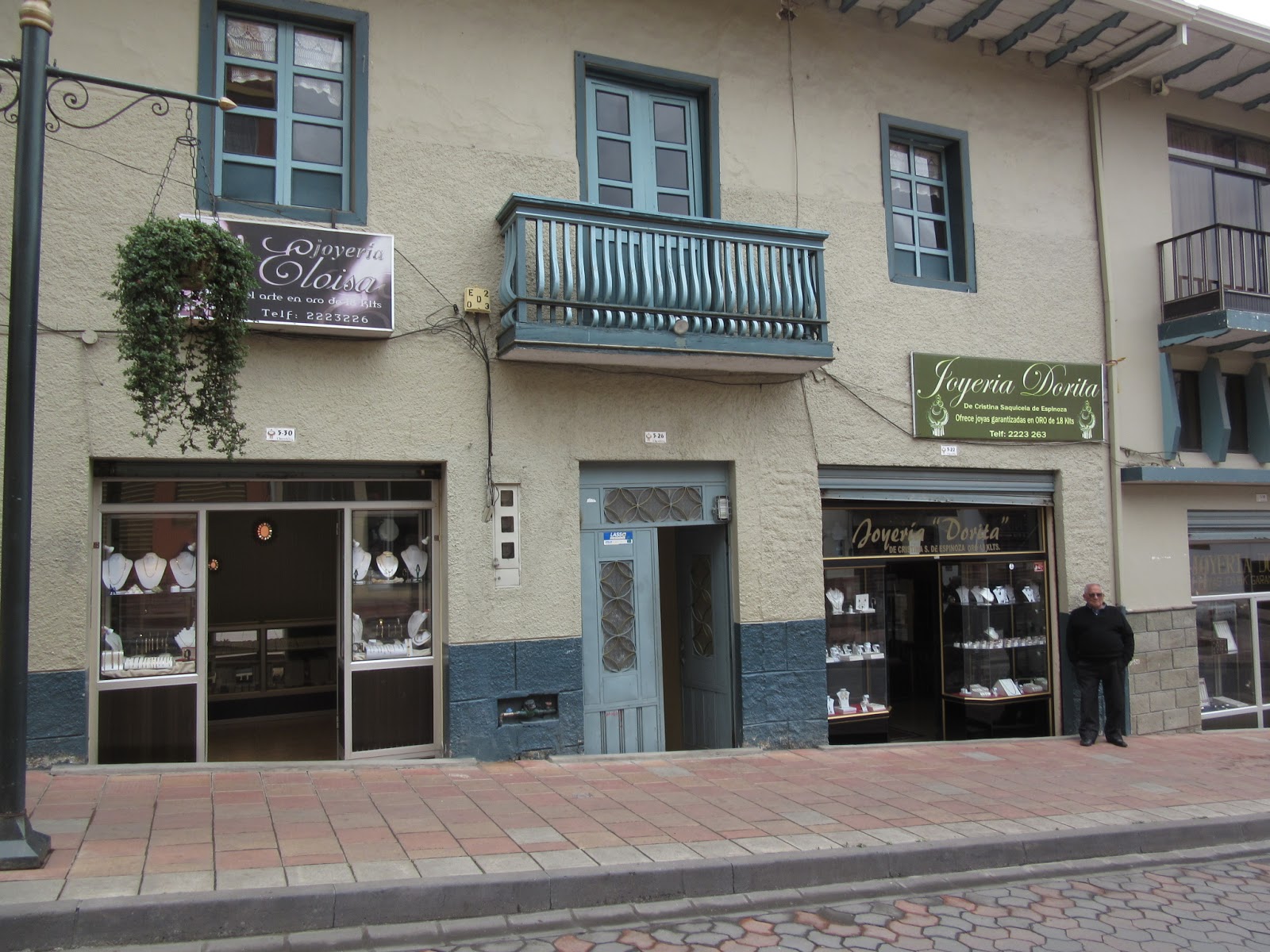
If you couldn’t find a silver item you liked in Chordeleg, there had to be something wrong as there were silver shops everywhere we looked. 


We were so relived we had come to Chordeleg as the town had a pretty church square.
Even the street lights looked like silver earrings!


There were just so many stores selling silver jewelry, especially filigree, it just boggled my mind. I was just overwhelmed with all the choices.

Nadine and I spent close to an hour in one shop while she looked for a gift for her mother and a ring for herself and I bought myself a second pair of earrings and a longer chain to go with a pendant I had also purchased in Otavalo. I have to give the men a lot of credit as they were remarkably patient while Nadine and I selected items and the salesclerk polished Nadine’s gifts. Plus, it had started raining to add to their discomfort while they waited outside the shop.
Oliver always seemed to have a bottomless stomach so he and Nadine found a place to have lunch. Steven and I bought some rolls and wandered through town some more instead.


It was a two-hour bus ride back to Cuenca through the mountains. The drive was picturesque but Steven and I had had enough of buses by then that day especially since we were also facing a longish ride the next morning to our next destination.
Once we got back to Cuenca and said our goodbyes to Nadine and Oliver, we looked for a place to eat dinner. We found the selection of restaurants in the downtown area to be pretty poor considering Cuenca was the country’s third largest city. Since we’re in no way ‘foodies,’ our standards or expectations are pretty low when it comes to finding a place to eat. We ended up at one that had no one else inside – one thing we normally try and avoid at all costs – but we were tired and hungry. Steven was happy with his hamburger and I was delighted with my chicken salad sandwich.
Steven and I said later we couldn’t believe we’d spent all day doing what felt like nothing! Neither of us could remember having a day like that on one of our trips before. Looking on the bright side, at least we saw some interesting scenery on our bus rides, spent some more enjoyable time with Nadine and Oliver and I bought earrings I love! So, all was not lost.

Although the central square and a few buildings surrounding it were pleasant, neither Steven or I were at all smitten with Cuenca. I had difficulty understanding why it’s considered to be a place to stop for tourists apart from its easy access to the breathtakingly beautiful El Cajas National Park. The sidewalks were in atrocious shape, the architecture generally unattractive except as listed above and graffiti sadly defaced so many buildings – it couldn’t be considered ‘street art’ as it didn’t have that beauty or sophistication so was just tagging.

Next post: Coastal city of Guayaquil, Ecuador.

Posted on October 28th, 2017 from Cusco, Peru. 

Friday, October 27, 2017

10/3: Cuenca, Ecuador: Medicine Women or Faith Healers?

Earlier on October 3rd, Steven and I had gone on one of our most exciting and challenging treks ever, trekking for several hours at an altitude of 12,500 ft in El Cajas National Park, near Cuenca, Ecuador. The hike was led by Milton, undoubtedly one of the most knowledgeable and fascinating guides one could ever hope for. Nadine and Oliver, two friends from Luxembourg, rounded out the small group.

During the hike, Milton had explained that twenty percent of the people in Ecuador were indigenous and many believed in the power of special spirits. Milton was  not indigenous but had come to believe that some people had certain powers. He told us one of the most interesting stories we’d heard in a long time. He related how his young son had gotten sick and both he and his wife could do nothing to alleviate his crying and fussiness. His granny was there visiting and offered to help as long as Milton agreed to pay her for performing a purification ritual on her great-grandson. Milton related how he was incredulous that his own granny would charge him and his wife but she maintained that she needed to be paid in order for their son to be healed.

Milton explained the 'healing' or cleansing or purification ritual involved picking a certain plant, brushing it repeatedly over the boy's head, back and tummy. Then she opened up an egg into a glass half full of water and peered at the shape of the egg. Because the egg was seen as the devil’s eye, Milton's granny was able to tell how their son might be. After making a sign of the cross while touching the top of the boy’s head, back and belly button, she then took a small swig of alcohol and spat on the boy’s face. 

Milton, who had been a non-believer in the ways of certain women who had special powers, said that his son immediately stopped crying after the ritual and began walking around again, evidently feeling fine. He and his wife now take their son twice a month to the ‘medicine women’ in Cuenca's market for preventative reasons as his granny only visits infrequently. Milton told us that we could all see the purification ritual taking place at one of the markets in town after our hike if we liked. We unanimously said we would enjoy that so we were dropped off at the market after the hike so we could watch the ceremony for ourselves.
 

I struggled writing the following description because of not knowing the correct terms to use. I don’t know whether the women providing assistance were or would consider themselves to be ‘medicine women’ or 'faith healers' or what exactly. Not knowing, I have used those terms interchangeably and hope that they are not offensive.
 
The Mercado 10 de Agosto was pretty large so we had difficulty finding the women until one of us remembered Milton having said the women would be under the staircases. We saw about 15 women, two groups of about eight under each staircase and just a few feet away from each other with each woman sitting on low stools. 
Most of them were busy with ‘clients’ working cheek by jowl, i.e. with no space in between the women and the clients for lack of a better word. I didn’t know where to look because so much was happening in front of us. I could only think it would be like having front row seats at a live theater performance where there are ten stages and the actors were simultaneously performing the same show but acting different scenes in it!
I had incorrectly assumed that only children would be the ones receiving aid from the faith healers because Milton had told us how his son was helped. However, we saw a number of men and women seeking solace although most of the clients were indeed children.
My eyes kept flitting back and forth among the faith healers and their clients as I didn’t want to miss a thing. However, I realized soon that I wasn’t getting a sense of the interaction between one healer and one client.


The four of us watched in absolute fascination as the faith healer 'hit' the woman for a good five minutes with about two-foot long leaves all over her body.

It was clear the leaves didn't hurt as the client only squirmed as the leaves were brushed all over.

Then the medicine woman rubbed an egg all over her.
Next the faith healer broke that same egg into a glass that was half full with water. The woman peered into it, reading it as if it were like tea leaves, so she could tell her client important information about what was contained in the egg and water mixture.

Clearly this wasn't the place to be if you were modest.
The faith healer then drank some spirits and spat some of it all over the young woman’s face and body. 

The faith healer then made a sign of the cross on the young woman's forehead, back and tummy. That concluded the cleansing or ritual. The same process and order of it was repeated with each client and each healer.

We noticed that the woman in red was the only one who talked to each parent the entire time the procedure was taking place. I wished I could have been a fly on the wall and understood what she was saying.


I found it interesting that one of the women performed the entire ritual while talking on the phone a good chunk of the time.

There was a steady stream of clients wanting or needing their services either for themselves or, more commonly, for their children. I was amazed that only one child seemed to have a tough time with any part of the long procedure and we must have stood there watching for close to an hour.
A photo of Nadine watching the cleansing ritual taking place.
We were all asked if we wanted to be cleansed or purified but we each said no, preferring to be gawkers rather than participants.
Other photos of the faith healers:

After watching the rituals with such fascination, I had so many questions: What did the women’s training consist of that enabled them to be regarded as ‘healers?’ Were they ‘chosen’ or selected to be healers or was it something they chose? Why were a few of the women particularly sought out by some clients as opposed to others? What did they charge or was the service done on a donation basis? How often do clients bring their children for the healings? were the rituals unique to Cuenca or did they take place in other cities across Ecuador, I wondered?
I could have continued watching the rituals for a lot longer but I think as it was, we stood pretty glued to our spots for close to an hour. I found the ceremony or ritual so intriguing because it was totally different from anything we’ve ever come across before.

The four of us strolled around the rest of the market for a bit but certainly nothing came close to capturing our interest for long.


I thought Steven looked very dapper in his 'Panama hat!'


Since none of us had been able to see the Catedral Vieja in Parque Calderon yet, we walked the few blocks there next. We hadn’t realized until then it was not a working church and that there was an admission fee because it was now the Museum of Religious Art.
I read that during the colonial period the church was known as the 'Parish of the Spaniards' as it was reserved for the people of Spain. The locals had to stay outside or worship in other places.  


In 1880 the construction of the New Cathedral began and with its consecration, the Old Cathedral ceased to be used for regular services. 


This chapel was built under the patronage of Benito Mendana who donated the best house in town to the Monastery of the Immaculate Conception in 1568. The altar was painted and gilded in 1868. The walls were bleached in 1930. 


This gorgeous chapel was built in 1573 under the patronage of Guillermo de Hernandez who belonged to a wealthy family who owned flour mills. It was consecrated to Our Lady of Sorrows in the 19th century.
The chapel's ceiling was particularly lovely.
 The Virgin with the Children fresco was painted in the 16th century.
It was sad to read that during the 1940s when the entire church was repainted with industrial paint, the beauty of the original decorations were hidden. The doors to the cathedral were closed in 1981 which contributed to the acceleration in the church's deterioration. Thankfully, restoration of the Old Cathedral was begun in 1999 as the Museum of Religious Art was a great addition to Cuenca.
Before saying goodbye to Nadine and Oliver after visiting the Old Cathedral, we made plans to meet in the morning to tour a couple of neighboring towns. On the way back to our hotel, we stopped at Cuenca's other market, the August 19th Market. I wondered why the city's markets were named after specific dates.

The market was pretty busy, not surprising given the approaching dinner hour.


Wish I knew what these were as we've also been seeing them here in Peru, too.


This couple was praying in front of the shrine located near the building's exit. I don't recall seeing a shrine inside a market building before.
We reached our hotel at 6 just seconds after the rain started. What perfect timing! We were both pleasantly tired after the long hike but not exhausted as we'd feared.

Next post: Riding the buses!

Posted on October 27th, 2017 from Cusco, Peru.