Let me apologize for the almost total absence of photos in this post. I didn't realize until a couple of days ago when I opened it up and noticed barely any of the photos I took on December 17th had, for some reason, been loaded in this post. Believe me, I am so bummed not to have any photographic record of the majority of our last day in Rio and Brazil!
We started off our last day in Rio, a Sunday, fittingly enough at Mosteiro de São Bento, the oldest church in Rio and one of the finest colonial churches in all of Brazil. It was founded in 1590 by Benedict monks, whose Order of Saint Benedict received from the Portuguese crown the possession of the hill it was built on. The order then baptized the hill as St. Benedict. As you may recall from my first post, the old downtown of Rio grew up on four hills. Only St. Benedict Hill and Conception Hill have survived because the two others were destroyed during the 20th century.
When we climbed the hill to the monastery, I remembered what they say about not judging a book by its cover as the church looked attractive, but not too impressive as we walked up to the entrance. However, once we stepped inside, we were blown away by the beautiful intricate work and gold everywhere. The high arched ceiling, alcoves and statuary were stunning and well worth the walk up the hill.
We had made a point of going to São Bento that morning to be there for the 10 am Mass being sung in Latin by the friars. The scent of incense was so strong we could even smell it as we entered the courtyard! It was so warm inside that many parishioners were fanning themselves with church bulletins. Because we had arrived too late, there was standing room only still available. Neither of us minded as it meant we could admire even more the sacred art and the gold, gold & more gold covering intricate carvings from our vantage point at the back. Thirty friars participated in the Mass including one much older one that was pushed in a wheelchair. The priests also run a school which is said to be one of the best in the city. Despite the large crowd attending Mass, the church was still a welcome island of beauty, silence and introspection.
Several days ago, we had stopped by the Igreja da Candelária but it had been closed so we returned in the hope it was also open on the Sunday morning. These photos were from our first visit to the grand Italianate temple that had long been the church for high-society citizens of Rio.
The quasi-legendary history about the establishment of the church is that in the beginning of the 17th century a ship called Candelária almost sank during a storm on the sea. Upon arriving in Rio de Janeiro, a Portuguese couple, António Martins Palma and Leonor Gonçalves sponsored the building of a small chapel, fulfilling the oath they made during the storm. This small chapel, dedicated to Our Lady of Candelária, was built around 1609.
 Built between 1775 and 1894, the church was modeled on Lisbon's Basilica de Estrela, a church I've just added to our sights to see in Lisbon when we're there for five nights in December this year. The marble for the stunning tile floor had been shipped from Verona, Italy. I was so glad the church was open this time so we could admire the beautiful painted ceiling, the leather seats and the nautical themes throughout.
Directly in front of the church seemed to be an unusual location for this nude sculpture, don't you think?
 As we walked through more of downtown Rio to the metro, it was sad that homelessness was a large part of life in the city center. It was a fact we couldn't escape from as was the intense stench of urine. Conversely, each of the metro stations was immaculately clean and we saw no signs of any graffiti at any of the stations or in any of the cars.
We couldn't leave Rio without spending time at the famous Ipanema and Copacabana beaches so we took the metro to Ipanema first. There we walked around the Hippie Fair in General Osório Square. The Sunday-only street market had stalls that featured items like clothing, leather goods, art and jewelry. We had a blast wandering around the Feira Hippie as it was the perfect place to look for some mementos of our trip to Brazil. Though who know us are familiar with how crowded the walls of our home are with pictures, paintings and even wall hangings from our adventures around the world. Now, one of the walls has a small painting that will always remind us of our time in Rio!
We were both antsy to get to the beach so we didn't dilly dally much longer and walked the few blocks to the Ipanema beach where it looked like half of Rio was spending their Sunday afternoon! For about ten bucks, we rented an umbrella and a couple of beach chairs from a fellow who set them up for us in one of the few empty spots. Without being asked, he made sure to put our backpacks around the chairs so there was no chance of their walking off as Steven's shoes, glasses, etc had done back in Valparaiso, Chile a while back!

 After a long while, we wandered down the sidewalk adjacent to the beach where we eventually came across the famous Girl from Ipanema statue. I so wish I could show you the photo I took of it. The statue was based on the song written by poet Vinicius de Moraes and composer Antonio Carlos Jobim as an homage to a beautiful teenager called Heloisa Pinheiro who, on her way to the beach, passed the cafe where the men often met for an afternoon beer. I had heard of the song made famous by Frank Sinatra so it was so neat seeing the statue that has captivated so many!
 In the late afternoon, we walked toward Arpoador, a massive rock dividing the iconic Ipanema and Copacabana beaches, and the main sunset spot people come to in Rio. It was so much fun clambering over the rock and taking in the gorgeous views of the setting sun. We continued walking toward Copacabana beach, marveling at the wave-patterned mosaic pavement on the way.
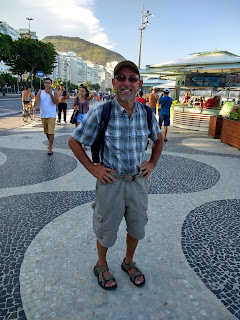 It was a fun walk to Copacabana as we could see people playing beach volleyball and a game called footvolley played entirely with the head and feet. All along the beach from Ipanema to Arpoador and ending at Copacabana were a series of twelve postos, concrete bunkers that served more than just lifeguard stations. The postos were like small 'neighborhoods' of bathers, each congregating in its own social type or groups - gays, couples, families, teenagers and so on. All along, beach side kiosks, cafes and stall after stall selling all manner of souvenirs were constant lures for us to stop and look and take out eyes off the beach. The day which had started out with peace and serenity from visiting two marvelous churches ended with our having having a blast on two of the country's most famous beaches. It seemed like the perfect way to say goodbye to Rio and Brazil and on to our last stop of our three plus month adventure to South America,

We started off our last day in Rio, a Sunday, fittingly enough at Mosteiro de São Bento, the oldest church in Rio and one of the finest colonial churches in all of Brazil. It was founded in 1590 by Benedict monks, whose Order of Saint Benedict received from the Portuguese crown the possession of the hill it was built on. The order then baptized the hill as St. Benedict. As you may recall from my first post, the old downtown of Rio grew up on four hills. Only St. Benedict Hill and Conception Hill have survived because the two others were destroyed during the 20th century.
When we climbed the hill to the monastery, I remembered what they say about not judging a book by its cover as the church looked attractive, but not too impressive as we walked up to the entrance. However, once we stepped inside, we were blown away by the beautiful intricate work and gold everywhere. The high arched ceiling, alcoves and statuary were stunning and well worth the walk up the hill.
We had made a point of going to São Bento that morning to be there for the 10 am Mass being sung in Latin by the friars. The scent of incense was so strong we could even smell it as we entered the courtyard! It was so warm inside that many parishioners were fanning themselves with church bulletins. Because we had arrived too late, there was standing room only still available. Neither of us minded as it meant we could admire even more the sacred art and the gold, gold & more gold covering intricate carvings from our vantage point at the back. Thirty friars participated in the Mass including one much older one that was pushed in a wheelchair. The priests also run a school which is said to be one of the best in the city. Despite the large crowd attending Mass, the church was still a welcome island of beauty, silence and introspection.
Several days ago, we had stopped by the Igreja da Candelária but it had been closed so we returned in the hope it was also open on the Sunday morning. These photos were from our first visit to the grand Italianate temple that had long been the church for high-society citizens of Rio.
The quasi-legendary history about the establishment of the church is that in the beginning of the 17th century a ship called Candelária almost sank during a storm on the sea. Upon arriving in Rio de Janeiro, a Portuguese couple, António Martins Palma and Leonor Gonçalves sponsored the building of a small chapel, fulfilling the oath they made during the storm. This small chapel, dedicated to Our Lady of Candelária, was built around 1609.


We couldn't leave Rio without spending time at the famous Ipanema and Copacabana beaches so we took the metro to Ipanema first. There we walked around the Hippie Fair in General Osório Square. The Sunday-only street market had stalls that featured items like clothing, leather goods, art and jewelry. We had a blast wandering around the Feira Hippie as it was the perfect place to look for some mementos of our trip to Brazil. Though who know us are familiar with how crowded the walls of our home are with pictures, paintings and even wall hangings from our adventures around the world. Now, one of the walls has a small painting that will always remind us of our time in Rio!
We were both antsy to get to the beach so we didn't dilly dally much longer and walked the few blocks to the Ipanema beach where it looked like half of Rio was spending their Sunday afternoon! For about ten bucks, we rented an umbrella and a couple of beach chairs from a fellow who set them up for us in one of the few empty spots. Without being asked, he made sure to put our backpacks around the chairs so there was no chance of their walking off as Steven's shoes, glasses, etc had done back in Valparaiso, Chile a while back!

We hadn't come to swim but to just 'be' there at the beach and take in the scenes around us. No one had to go hungry or thirsty or lack anything much while on the beach because every couple of minutes someone would wander by selling snacks, drinks, cigarettes, sunglasses, sarongs - you name it, it could be purchased without moving from the comfort of our chairs! I remember the air being redolent of dope being smoked or 'inhaled' as per Bill Clinton! We had books with us but neither of us read much, content with taking in the nonstop activity around us.
I read that on any given summer weekend, which was when we were there, up to a half-million Rio residents, known as cariocas, and tourists descend on the beaches and streets of Ipanema and Copacabana. On New Year's Eve, more than three million people take to the streets and the sand to take in the new year!


Next stop: A whirlwind tour of Mexico City.
Posted on June 15th, 2018, from stormy Grayton Beach on Florida's Panhandle.
Posted on June 15th, 2018, from stormy Grayton Beach on Florida's Panhandle.


